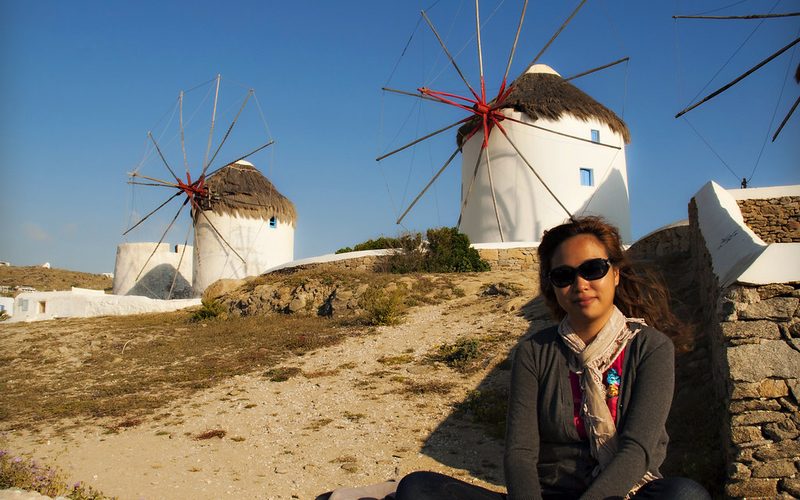
Mykonos is a Cycladic island in the Aegean Sea, covering 85 square kilometres, with a permanent population of roughly 10,000 residents and one of the most developed beach and nightlife scenes in Greece. It sits 150 kilometres southeast of Athens and is reachable by ferry or a 45-minute domestic flight. For travellers building a broader Greek island itinerary, LAACOUSTICMUSICFESTIVAL.COM provides destination guides across multiple archipelagos. Mykonos combines cosmopolitan infrastructure with Cycladic architecture: whitewashed cube houses, blue-domed chapels, and the famous row of windmills at Kato Mili overlooking the old port.
The island draws over 1 million visitors per year. Tourism accounts for approximately 85% of its economy. Visitors come primarily from the United States, France, the United Kingdom, Italy, and Germany. The shoulder season — late May to early June and September to early October — offers the same landscape with 40–50% fewer crowds and accommodation prices averaging 35% lower than peak rates.
What Is Mykonos Famous For?
Mykonos is famous for its beach clubs, cosmopolitan nightlife, the whitewashed maze of Mykonos Town (Chora), and the iconic row of 16th-century windmills at Kato Mili that overlooks Little Venice and the old harbour.
The island operates as Greece’s premier party destination, hosting beach clubs at Paradise Beach and Super Paradise Beach that draw international DJs from June through September. Mykonos Town’s Little Venice neighbourhood — a row of Venetian-era houses built directly over the sea — is photographed more than any other spot on the island. The windmills at Kato Mili date from the Venetian occupation and originally processed the island’s grain; 7 of the original mills are preserved and open for photography.
Beyond nightlife, Mykonos holds 25 named beaches, 400+ churches and chapels, and a pelican named Petros who has lived in the port area since the 1950s, becoming a living symbol of the island.
How Do You Get to Mykonos?
Mykonos is reached by ferry from Piraeus (4.5 hours by high-speed catamaran, 7–9 hours by conventional ferry), from Rafina port (2.5–3 hours, closer to Athens airport), or by direct flight to Mykonos Island National Airport (IATA: JMK).
Rafina ferry terminal is 8 kilometres from Athens International Airport (ATH) — significantly closer than Piraeus, which sits 40 kilometres from the airport. Travellers arriving on international flights save 45–60 minutes of transfer time by using the Rafina route. Ferry operators on the Athens–Mykonos route include Hellenic Seaways, SeaJets, and Golden Star Ferries. Ticket prices range from €25 for conventional ferry seats to €80 for business-class seats on high-speed catamarans.
Mykonos Airport receives direct international charter and scheduled flights from London Heathrow (British Airways), Amsterdam (KLM), Paris CDG (Air France), Rome Fiumicino (ITA Airways), and Dubai (Emirates). Domestic flights from Athens run approximately 12 times daily with Aegean Airlines and Sky Express, with a 45-minute flight time. For travellers visiting their first Greek islands, the Greek islands guide covers inter-island ferry logistics and routing in detail.
When Is the Best Time to Visit Mykonos?
The best time to visit Mykonos is June and September — temperatures average 27°C in June and 25°C in September, sea stays above 23°C, and beach clubs run at full capacity with 40–50% fewer crowds than July and August.
July and August represent peak season, with daily highs reaching 33–36°C and overnight minimums rarely dropping below 24°C. Hotel occupancy hits 95–100% in the last 3 weeks of August. Accommodation booked less than 2 months before an August arrival will typically cost 60–80% more than the same room reserved in January. Ferry seats on the Athens–Mykonos catamaran sell out 2–3 weeks in advance during peak weeks.
April and May offer cooler temperatures (18–23°C), fully open infrastructure, and prices 50% below peak. October remains warm enough to swim (sea at 22°C) and almost all restaurants and hotels stay open until mid-October. The island effectively closes from November to mid-April, when most tourist infrastructure shuts down.
What Are the Best Beaches in Mykonos?
The 6 best Mykonos beaches are: Paradise (party beach, beach clubs), Super Paradise (bay setting, mixed crowd), Psarou (luxury sunbeds, celebrity scene), Ornos (family-friendly, calm water), Elia (600 metres, quieter), and Agios Sostis (no facilities, natural).
- Arrive at Paradise Beach before 11:00 to secure a sun lounger — by noon in July and August, all beds are taken and the crowd becomes very dense.
- Book a sunbed at Psarou Beach at least 48 hours in advance; Nammos beach club charges €80–200 per bed but includes waiter service and sea views from an elevated deck.
- Take the free shuttle boat from Ornos Bay to Psarou and Super Paradise rather than renting a vehicle — shuttle service runs every 30 minutes from 10:00 to 18:00.
- Visit Elia Beach for a calmer atmosphere — it lies on the island’s southern shore, 12 kilometres from Mykonos Town, and holds 3 organized beach bars without the loud DJ music of Paradise.
- Reach Agios Sostis via a 20-minute drive on a dirt road from Ano Mera village — no sunbeds, no bar, no music, just 200 metres of sand and clear Aegean water.
The island’s southern coast concentrates most organized beaches. Northern beaches (Panormos, Agios Sostis) stay windy in summer but attract those seeking undeveloped natural settings.
What Is the Nightlife Like in Mykonos?
Mykonos nightlife runs across 3 zones: Mykonos Town bars (open from 22:00, peak midnight), beach clubs at Paradise and Super Paradise (afternoon to evening), and Cavo Paradiso open-air club above Paradise Beach (midnight to 10:00, international DJs).
Cavo Paradiso is Greece’s most internationally recognised nightclub. It operates at 180 metres altitude overlooking the Aegean, with a capacity of 4,000 and an outdoor dancefloor. It has hosted Carl Cox, David Guetta, Tiësto, Armin van Buuren, and Paul van Dyk among its DJ roster. Entry costs €40–80 depending on the DJ, and shuttle buses from Paradise Beach run throughout the night.
Mykonos Town holds concentrations of bars along three streets: Matogianni Street, Mitropoleos Street, and the Little Venice waterfront. Cocktail prices average €16–22, significantly above mainland Greek bar prices. Gay nightlife concentrates around Pierro’s Bar near the old harbour, one of Europe’s longest-running gay venues, which has operated continuously for over four decades.
What Is Mykonos Town Like?
Mykonos Town (Chora) is a whitewashed labyrinthine settlement of 1,000+ interconnected alleys, 400 chapels, 2 main squares (Manto Square and the harbour square), the Matoyianni shopping street, the Little Venice waterfront, and the Kato Mili windmills — all contained within an area of roughly 0.5 square kilometres.
The deliberate maze layout of Chora was designed during the medieval period to disorient pirates who landed on the island. Streets rarely run straight for more than 30 metres before turning or branching. Navigating by landmarks rather than by direction is the standard approach: from the windmills, turn toward the sea to reach Little Venice; from Manto Square, follow the marble-paved lane downhill to reach the harbour. Google Maps functions reliably in the town but the narrow lanes make cycling or driving impossible — Chora is pedestrian-only within its medieval core.
The Archaeological Museum of Mykonos, housed near the ferry port, displays 7th-century BC Protogeometric and Geometric pottery from the nearby island of Rinia, as well as an early Archaic pithos (storage jar) with narrative relief panels depicting the Trojan Horse — one of the oldest known depictions of the myth.
What Are the Best Restaurants in Mykonos?
Mykonos restaurants divide into 3 price tiers: budget (€10–18 per person for souvlaki, gyros, and grilled fish at harbour tavernas), mid-range (€30–55 per person at Matoyianni street restaurants), and luxury (€80–150+ per person at venues like Nobu Mykonos, Spilia, or Scorpios Beach Club dining).
Seafood dominates menus across all price points. Fresh catches of sea bream, red mullet, and squid come from the island’s fishing boats landing daily at the old harbour. A grilled sea bream costs €20–35 at a mid-range taverna, rising to €55+ at premium waterfront restaurants. Lobster pasta, a Mykonos signature dish, appears on most upscale menus at €45–75 per portion.
Budget eating options include the souvlaki stalls along the back streets of Chora (€3–5 per skewer), the covered market near Fabrika Square (fresh bread, cheese, and local produce), and the kafeneion coffee shops in Ano Mera village — where a Greek coffee costs €1.80 and the clientele is almost entirely local.
How Does Mykonos Compare to Santorini?
Mykonos and Santorini are the two most visited Greek islands, but they serve different travellers — Mykonos focuses on beach clubs, nightlife, and fashion retail, while Santorini centres on volcanic landscape, wine, and architecture photography.
Santorini receives approximately 2 million visitors per year; Mykonos receives just over 1 million but at comparable accommodation density. Nightlife in Santorini ends by 02:00 in most venues, while Mykonos clubs operate until dawn. Beaches in Santorini are black or red volcanic sand, mostly without organized sun-lounger infrastructure; Mykonos beaches are white-sand with full beach-club amenities. Accommodation costs are broadly equivalent at the luxury tier but Mykonos has fewer budget options. The comprehensive Santorini travel guide covers everything from Oia sunsets to caldera sailing tours for travellers weighing both destinations.
What Shopping Is Available in Mykonos?
Mykonos Town’s Matoyianni Street holds 60+ boutique shops selling international luxury fashion (Gucci, Dolce & Gabbana, Bulgari), Greek jewellery, hand-painted ceramics, and linen clothing — it concentrates the island’s retail within a 700-metre pedestrian lane.
Greek jewellery is a standout purchase. Mykonos silversmiths produce original pieces using traditional Greek motifs — evil-eye charms (mati), Olympian figures, and Cycladic geometric patterns. Prices for silver pieces start at €25 for small pendants and reach €500+ for elaborate bracelets. Gold shops on the main harbour offer contemporary and classical designs; the Greek government guarantees gold purity through a hallmark system requiring pieces to be stamped with the Lion of Athens mark.
Local food products worth buying: Mykonos kopanisti (a spicy fermented cheese protected by EU designation of origin), thyme honey, and white wines from the Cyclades. Most deli shops and minimarkets on Chora’s main streets carry vacuum-packed kopanisti for travel.
What Water Sports Are Available in Mykonos?
Mykonos offers 8 main water sport activities across its organized beaches: jet-skiing (Paradise and Ornos, €60 for 15 minutes), windsurfing (Korfos Beach, with Beaufort 4–5 winds), kitesurfing (Korfos, with certified instruction), parasailing (Ornos and Platys Gialos, €60 per person), scuba diving, snorkelling tours, banana boat rides, and wakeboarding.
Korfos Beach on the northeast coast is Mykonos’s best windsurfing and kitesurfing location. Consistent thermal winds, averaging 20–28 knots in July and August, make it suitable for intermediate and advanced riders. Planet Windsurfer operates at Korfos, offering board and wetsuit rental for €45 per hour and certified instruction for beginners at €120 for a 3-hour introductory session.
Scuba diving operates from the Mykonos Diving Centre in Psarou, offering 12 dive sites around the island. The most popular is the Magoulas wreck — a cargo ship in 18 metres of water — and the rocky reefs at Delos Channel, where visibility reaches 25–30 metres in calm conditions. A standard introduction dive costs €65 for non-certified divers; PADI Open Water certification courses run €420 over 3 days.
What Is the Delos Day Trip?
Delos is an uninhabited sacred island 2 kilometres southwest of Mykonos, holding one of Greece’s most significant archaeological sites — the birthplace of Apollo and Artemis in Greek mythology — and reachable by a 20-minute ferry from Mykonos Old Port.
The archaeological site of Delos covers the entire island and holds ruins spanning the 9th century BC through the 1st century AD. Key monuments include: the Terrace of the Lions (original Archaic marble statues now replaced by replicas, originals in the Mykonos Archaeological Museum), the House of the Dolphins (mosaic floor depicting Eros riding dolphins, dating to 100 BC), the Sanctuary of Apollo (temple complex spanning 700 years of construction), and the Theatre Quarter (a residential area from the Hellenistic period with intact mosaic floors).
Ferries to Delos depart from Mykonos Old Port at 09:00 and 10:00; the last return boat leaves Delos at 15:00. Tickets cost €22 for the boat plus €12 for site entry. The site has no shade and temperatures on the exposed plateau reach 38°C in August — bring water and sun protection. Allow 2–3 hours to walk the main circuit.
What Is the Ano Mera Village?
Ano Mera is Mykonos’s only inland village, located 8 kilometres from Mykonos Town, holding the Monastery of Panagia Tourliani (founded 1580) with a marble tower and intricately carved interior, a central plateia square with tavernas, and a population of 700 permanent residents.
Ano Mera provides a contrast to the tourist-oriented Chora. The central square holds 4 traditional tavernas serving grilled lamb chops, village salads, and moussaka at prices 30–40% lower than Mykonos Town. The Monastery of Panagia Tourliani is an active religious site displaying Cretan icons, an elaborately carved marble iconostasis, and embroidered vestments. Visiting hours run 09:00–13:00 and 17:00–20:00; dress code is modest (covered shoulders and legs).
The Folklore Museum of Mykonos sits on the road from Chora to Ano Mera. It houses traditional Mykonian household objects, textiles, farm tools, and an 18th-century bedroom reconstruction inside a traditional Cycladic house. Entry is free.
How Do You Get Around Mykonos?
Transport options in Mykonos are: the Old Port bus (KTEL, covering southern beaches from Ornos, flat fare €1.80), the Fabrika bus (covering northern beaches and Ano Mera), water taxis from Old Port to beaches, ATV and scooter rental (€25–45 per day), and car rental (€55–120 per day).
The KTEL bus system runs 2 main routes from Mykonos Town. The southern route covers Ornos, Platys Gialos, Psarou, and Paraga. The northern route covers Tourlos, Agios Stefanos, Korfos, and Ano Mera. Bus frequency reaches every 20–30 minutes in peak season. Buses do not reach Paradise or Super Paradise Beach directly — water taxis from Platys Gialos or Ornos serve these.
ATV and scooter rental is the most flexible option for beach-hopping. The island road is paved throughout but narrow, with some steep sections approaching Super Paradise. Speed limits are 50 km/h on island roads and 30 km/h in Chora. Traffic in Mykonos Town becomes very congested from 17:00 to 20:00 as beach-goers return, and from 22:00 to 01:00 as the evening social starts.
What Accommodation Options Exist in Mykonos?
Mykonos accommodation divides into 5 categories: luxury cliff-top hotels (€500–2,000 per night, e.g. Cavo Tagoo, Mykonos Blu), boutique Chora hotels (€180–450), beach-adjacent resort hotels at Ornos and Psarou (€250–600), budget guesthouses in Lakka district (€80–150), and private villa rentals for groups (€400–1,500 per night for 4–8 bedroom villas).
Cavo Tagoo Hotel is consistently rated among Greece’s top 10 luxury properties. It holds 72 rooms and suites carved into a hillside 1 kilometre from Chora, with infinity pools facing the caldera view and private pool access in suites from €800 per night. Mykonos Blu resort in Psarou combines beach club access with a 5-star hotel, charging €450–900 for double rooms in peak season.
Budget travellers find the best prices in Lakka district — a residential neighbourhood 10 minutes’ walk from the harbour — where family-run guesthouses charge €80–140 for double rooms in shoulder season. Hostel accommodation exists at a small number of locations near Mykonos Town and Ornos, with dorm beds starting at €35 per night in June.
What Things to Do in Mykonos Beyond Beaches?
Beyond beaches, 7 activities define the Mykonos experience: Delos day trip, sunset cocktails at Little Venice, sunset viewing from the Kato Mili windmills, luxury shopping on Matoyianni Street, the Archaeological Museum, Folklore Museum at Ano Mera, and the Paraportiani Church photography walk.
Paraportiani Church is one of the most photographed buildings in Greece. It is not a single church but a cluster of 5 chapels built between the 14th and 17th centuries, organically fused into a single structure over generations. The whitewashed compound sits at the entrance to the Kastro neighbourhood and photographs best in the morning light (08:00–10:00) before tour groups arrive. No entry is permitted inside unless a religious service is in progress.
Little Venice at sunset (from 19:30 in summer) is the most atmospheric time to visit. Tables at the waterfront bars hang directly over the Aegean. Cocktails cost €18–24, but the 40-minute golden-hour window offers the best light for photography of the windmills and the passing sailing boats. Reserving a table at the café directly below the Kastro neighbourhood secures the best sightline to the windmill row. For ideas on combining Mykonos with a Santorini visit, the things to do in Santorini guide covers the key cultural and natural highlights across the Cyclades.
What Is the History of Mykonos?
Mykonos was first settled by Ionians from Athens around 1000 BC — it later served as a commercial hub during the Classical and Hellenistic periods due to its proximity to Delos, the sacred island that attracted trade from across the Aegean.
The island’s commercial importance in antiquity derived from Delos. All Mediterranean trade heading through the Cyclades passed near Mykonos, and the island supplied Delos with fresh water, food, and building materials during the period of Delian commerce (3rd–1st century BC). Delos became the main slave market of the ancient Mediterranean during the Hellenistic period, handling up to 10,000 transactions per day at its peak.
Mykonos passed through Byzantine, Venetian, and Ottoman control before Greek independence. The Venetians controlled the island from 1207 and built the Kastro neighbourhood in Mykonos Town. During the Greek War of Independence, the island’s heroine Manto Mavrogenous funded and led naval operations against Ottoman forces — the main square in Mykonos Town is named after her. Her statue stands at the harbour entrance.
What Are the Best Sunset Spots in Mykonos?
The 4 best sunset spots in Mykonos are: Little Venice waterfront (iconic windmill silhouette backdrop), Kato Mili windmill ridge (elevated view over the sea), Armenistis Lighthouse on the northwest cape (no crowds, 360-degree sea view), and the hilltop terrace at Cavo Tagoo Hotel (accessible to non-guests for drinks).
Armenistis Lighthouse sits on the westernmost point of Mykonos, 6 kilometres from Chora. Reaching it requires a 15-minute drive plus a short walk on a gravel path. The lighthouse, painted white and red, has stood since 1891. Sunset from the cape is unobstructed — the sun drops directly into the Aegean to the west. Unlike Little Venice, which crowds heavily by 20:00, Armenistis rarely has more than 10–15 visitors at sunset.
Little Venice sunset starts crowding from 18:30 in summer. Arriving by 18:00 and securing a table with a view of the windmills is essential in peak season. The windmills begin casting shadows onto the water at 19:00, and the golden-hour window lasts approximately 40 minutes before the sun drops below the horizon.
What Should First-Time Visitors Know About Mykonos?
First-time visitors to Mykonos need to know 5 practical facts: cash is widely needed (many beach bars and small shops are card-free), the Chora maze is intentional (navigation by landmark works better than direction), beach clubs require advance booking in July–August, ferry connections to Santorini and other Cyclades run daily, and noise levels from beach clubs reach 90+ decibels at peak hours.
ATMs are available at 4 locations in Mykonos Town (near Manto Square, near the harbour, at Fabrika bus station, and on Matogianni Street). Withdrawal fees of €2–4 per transaction apply at all Mykonos ATMs for foreign cards. Cash-in-hand transactions are common at beach markets and smaller traditional shops. Budget for €50–100 in cash per day for incidental spending.
First-time visitors underestimate the Chora maze. Phone GPS does function but the alley intersections occur every 10–20 metres, and wrong turns are frequent. Landmarks to memorize: the windmills (high ground, western edge), the harbour (eastern edge), and the red-door church of Paraportiani (north side of Kastro). From those 3 anchors, most of Chora is reachable within a 5-minute walk. For a broader perspective on first visits to the Cyclades, the Santorini unveiled guide offers comparable orientation advice for Mykonos’s volcanic southern neighbour.
What Budget Should You Plan for Mykonos?
A mid-range Mykonos daily budget runs €200–280 per person, covering accommodation (€90–140 for a studio), meals (€50 for two), transport (€20 scooter share or ATV), drinks (€40 for 2 cocktails at a beach club), and one entry or excursion (€20–35).
Budget travellers can reduce daily costs to €100–130 by staying in Lakka guesthouses, eating gyros and souvlaki (€4–6 per meal), using the KTEL bus exclusively (€1.80 per ride), and visiting free attractions (Paraportiani, windmills, Delos — ferry ticket required). Luxury spending runs €600–1,500+ per day when adding private beach club beds (€200–500), premium restaurant dinners (€100–150), and hired transportation (€250–400 for a private motorboat day charter).
Mykonos is the most expensive Greek island for day-to-day spending. A basic coffee costs €3.50–5 in a Chora café. A litre bottle of water at a beach kiosk runs €2.50. A taxi from the airport to Mykonos Town costs a flat €25.
How Does Mykonos Connect to the Ionian Islands?
Mykonos connects to the Ionian Islands through Athens — there is no direct ferry between the Cyclades and the Ionian; travellers return to Piraeus or Rafina by ferry, then travel overland or by domestic flight to access Corfu, Lefkada, or Zakynthos.
A two-island itinerary combining Mykonos with a western Greek island requires 2 travel days for inter-island transit. Athens acts as the routing hub. Travellers who want to contrast Aegean and Ionian landscapes often combine 4–5 days in Mykonos with 4–5 days in Lefkada, which offers calmer village character and the spectacular Porto Katsiki cliffside beach. The Lefkada by car guide covers the island’s driving circuit in practical detail for those planning a combined Aegean–Ionian trip.
The Ionian and Aegean island groups differ in geology, climate, and character: the Ionians receive more rainfall, are greener, and lack the dry-scrubland aesthetic of the Cyclades. Mykonos’s crystalline light and bone-dry summer terrain define Cycladic aesthetics; Lefkada’s emerald bays and forested hillsides represent the Ionian counterpart.
What Are the Practical Entry and Health Requirements for Mykonos?
EU citizens enter Greece with a national ID card; non-EU visitors (US, UK, Australia, Canada) need a valid passport and receive 90 days visa-free access under Schengen rules — no prior visa or health documentation is required for most nationalities.
Greece uses the Euro (€). Pharmacies in Mykonos Town stock standard medications and English-speaking pharmacists are available in the 3 main pharmacies on Matoyianni Street and near Fabrika Square. The island’s health centre (open 08:00–20:00 daily in summer, weekdays only in winter) handles non-emergency medical care. EU citizens present the EHIC/GHIC card for reduced-cost treatment. Travel insurance covering medical evacuation is recommended — helicopter evacuation from Mykonos to Athens for a serious injury can cost €4,000–8,000 without insurance coverage.
Emergency numbers: 112 (general EU emergency), 166 (ambulance), 100 (police). The Mykonos Port Authority monitors distress calls on VHF Channel 16 for maritime emergencies.
What Wildlife and Environment Can You Find in Mykonos?
Mykonos’s dry Cycladic landscape supports 3 notable wildlife species: the loggerhead sea turtle (Caretta caretta, nesting at Fokos Beach), the Mediterranean monk seal (occasionally sighted off northern capes), and the Eleonora’s falcon (nesting on sea cliffs, present April–October).
Fokos Beach on the northeast coast is a protected turtle-nesting site. The Greek environmental organisation ARCHELON monitors and protects nests from June through August. Visitors should avoid Fokos after sunset during nesting season and stay clear of any orange-staked perimeter markers. The beach has no facilities and requires a 25-minute off-road drive from Mykonos Town.
The island’s interior scrubland holds Hermann’s tortoise (Testudo hermanni) and several raptor species. Birdwatching in the spring migration period (April–May) yields sightings of 40+ passing species including marsh harriers, hoopoes, and bee-eaters using Mykonos as a Aegean stopover point en route from Africa to northern Europe.
Frequently Asked Questions About Mykonos
Is Mykonos suitable for families with children?
Mykonos accommodates families at specific beaches. Ornos Beach has shallow, calm entry water extending 20 metres from shore, a beach restaurant with children’s menus, and a sandy bottom free of rocks. Platys Gialos Beach has similar sheltered conditions. The party beaches (Paradise, Super Paradise) are not appropriate for children due to loud music, crowding, and nightlife. Families should book accommodation in Ornos or Platys Gialos to stay within walking distance of the family-friendly beach zone. The Delos day trip suits children aged 8+ who can walk 2–3 kilometres on an archaeological site with limited shade.
Is Mykonos expensive compared to other Greek islands?
Mykonos is the most expensive Greek island for accommodation, food, and nightlife. A beach club sun-lounger costs €60–200 compared to €8–20 on Skiathos or Naxos. A cocktail in a Chora bar costs €18–24 versus €8–12 on a typical Aegean island. Accommodation rates are 40–60% higher than Santorini and 100–150% higher than islands like Naxos or Samos. Budget travel is possible but requires staying outside the town core and avoiding beach clubs entirely.
What is Paradise Beach really like?
Paradise Beach is a 250-metre sandy bay on the southern coast, 5 kilometres from Mykonos Town. It holds 3 beach clubs (Tropicana, Cavo Paradiso, Paradise Beach Club) running continuous music from 10:00 to 23:00. Sun loungers cost €20–40 per bed and are laid in dense rows covering most of the beach. The water is clear and the bay’s sheltered shape produces calm conditions. In peak season (late July–August), the beach becomes extremely crowded and noisy — more of a festival environment than a swimming beach. In June and September, the same infrastructure operates at 30–40% capacity and the experience is more manageable.
Can you visit Mykonos without spending on nightlife?
A Mykonos visit without nightlife spending is entirely feasible. The archaeological sites (Delos, Chora walking tour, Paraportiani, Mykonos Museum) are affordable. Beaches without beach clubs exist at Fokos, Agios Sostis, and Panormos. The Folklore Museum in Ano Mera is free. Sunset viewing at Armenistis Lighthouse costs nothing. Budget tavernas in Ano Mera and in the residential alleys of Chora serve meals for €12–20 per person. The island’s nightlife infrastructure is prominent but not obligatory — visitors can structure 5 days in Mykonos spending under €100 per day.
How does Mykonos compare to other Cycladic islands for beaches?
Mykonos has 25 named beaches on 85 square kilometres — a density of roughly 0.3 beaches per square kilometre. Naxos has 20 named beaches on 428 square kilometres but its beaches are longer (Agios Prokopios stretches 3 kilometres). Paros has 45 beaches on 196 square kilometres. Mykonos beaches score highest for organised infrastructure (sunbeds, beach bars, water sports) but rank lower than Naxos and Milos for natural, uncrowded settings. Travellers who prioritise beach environment over nightlife and entertainment consistently prefer Naxos or Milos; travellers who want beach clubs and nightlife within the same destination choose Mykonos.
Read more
Explore more from Cameron Hornbostel: