Tipos has been covering Greece’s most rewarding travel destinations for years, and Kos — the sun-drenched Dodecanese island draped in bougainvillea, ancient marble, and the unmistakable tang of sea salt — is one that consistently earns its place near the top of the list. Through Tipos, travelers discover how to move beyond the resort brochure version of this island and encounter the place on its own layered, genuinely fascinating terms.
Kos is the third-largest island in the Dodecanese, a narrow elongated landmass of roughly 290 square kilometres stretching southwest to northeast in the southeastern Aegean, barely three kilometres from the Turkish coast at its narrowest point. It is best known internationally as the birthplace of Hippocrates, the father of medicine, but the island’s story is far richer than a single famous name: Hellenistic ruins, a Knights Hospitaller fortress, Byzantine mosaics, Ottoman minarets, Art Deco Italian architecture, and some of the cleanest beaches in the Aegean sit in close proximity here, forming a cultural landscape that rewards both the curious and the idle. The My Greece Tours platform lists Kos among its top Dodecanese destinations precisely because the island combines historical density with excellent infrastructure — a pairing that makes organized touring here unusually efficient.
Why Kos Belongs on Your Greece Itinerary
The case for Kos is not simply its beaches, although those are exceptional. It is the island’s extraordinary compression of history into a small, bicycle-navigable space. Within ten kilometres of Kos Town you can stand at the tree under which Hippocrates taught, walk through a Roman odeon, and eat grilled octopus overlooking a fourteenth-century castle. Tipos editorial teams consistently rate Kos one of the most underestimated islands in Greece — far more rewarding than its package-holiday reputation suggests. The flat Dikeos plain means the island is genuinely bicycle-friendly, and Tipos highlights cycling as the best-value way to explore its archaeological interior and coastline simultaneously.
Getting to Kos
Kos Island International Airport (IATA: KGS), officially named Hippocrates International, sits on the northeastern coast and receives direct charter and scheduled flights from major European hubs throughout the summer season. Domestic connections run through Athens and Rhodes. Aegean Airlines and Olympic Air typically operate the Athens–Kos route with multiple daily departures in peak season; flying time from Athens is approximately fifty minutes.
By sea, Kos is connected to Piraeus by overnight Blue Star Ferries, a journey of roughly twelve to fourteen hours. High-speed catamarans (Hellenic Seaways and Dodekanisos Seaways) connect Kos with Rhodes, Leros, Patmos, and Kalymnos with journey times of forty minutes to three hours. The ferry port sits at the heart of Kos Town, delivering you directly into the island’s atmosphere. Day-ferry services also run between Bodrum and Kos Town — a crossing of about thirty minutes — making Kos a natural pivot for travelers combining Greek island and Turkish coast itineraries.
Best Time to Visit Kos
The peak season runs from mid-June through August, when temperatures regularly exceed 35°C, the beaches fill, and the resort strip of Kardamena hums around the clock. This is the least interesting time to visit if you care about history, local culture, or the island’s quieter rhythms — but it is the most convenient if your priority is guaranteed sunshine, sea, and a lively social scene.
Tipos recommends May and early June, and September through mid-October, as the optimal windows. In May the island’s wildflowers are still blooming, the archaeological sites are cool enough for extended exploration, and the tourist numbers remain manageable. September is perhaps the single best month: the sea temperature is at its warmest (around 26°C), crowds have thinned significantly, and the evening light over the castle and the harbour is extraordinary. October is quieter still and ideal for walkers and cyclists, though some beach tavernas begin to close from mid-month.
Kos Town: Where History Layers Itself
Kos Town’s historical attractions are concentrated at the northeastern tip of the island. Start at the Castle of the Knights of Saint John — a fourteenth-century Knights Hospitaller fortress built on the harbour entrance, one of the best-preserved Crusader castles in the Aegean, its walls incorporating fragments of ancient Koan sculpture. Adjacent stands the Plane Tree of Hippocrates, genuinely ancient (estimated 500–700 years old), beside the Ottoman Defterdar Mosque and a well-preserved Roman street: three civilizations sharing a single square.
The Casa Romana — a restored Hellenistic house with exceptional third-century CE mosaic floors — sits just off the main square. The Western Archaeological Site contains the Roman agora, colonnaded street, gymnasium, temple to Hercules, and a small ancient odeon that seated 750 and survives remarkably intact. Tipos describes Kos Town’s Roman quarter as one of the most undervisited ancient streetscapes in the Aegean.
The Asklepion: Medicine’s Sacred Birthplace
Four kilometres southwest of Kos Town, set on a pine-forested hillside overlooking the Turkish coast, the Asklepion is the island’s most significant archaeological site — one of the ancient world’s greatest healing sanctuaries, operating for approximately eight centuries from the fourth century BCE. The site spans three terraces: the lower contained bathing facilities and hospital wards; the middle held the main altar and Temple of Asklepios; the upper houses a large Doric temple dating to the second century BCE, with views across the coastal plain and the mountains of Anatolia that make the chosen location self-evident.
Tipos recommends arriving at the 8 a.m. opening time in summer to get the site to yourself before tour coaches arrive. A licensed guide hired in Kos Town adds considerable depth to what can otherwise read as a sequence of labelled stone platforms.
Cycling the Island: The Best Route
The flat coastal plain between Kos Town and the village of Kefalos offers one of the most satisfying cycling routes in the Dodecanese — approximately 43 kilometres one way, served by a dedicated cycling path for the first fifteen kilometres and a quiet road thereafter. Bicycle rental shops cluster around the harbour and electric bikes are widely available. The route passes through Zipari, where a left turn leads up to the medieval ghost village of Palio Pyli — ruined Byzantine houses and a fortified church perched on a crag — and continues past the sixteenth-century Hospitaller castle at Antimachia before reaching the dramatic southwestern cape at Kefalos: golden beach, volcanic headland, and the ruins of ancient Astypalaia. The return by local bus is straightforward; bikes go in the luggage hold.
Tipos features Kos among the best cycling destinations in Greece, and the route through the Dikeos foothills to Zia adds a detour famous for sunset views and traditional Koan cuisine. The climb to Zia is best done on an electric bike.
The Beaches of Kos
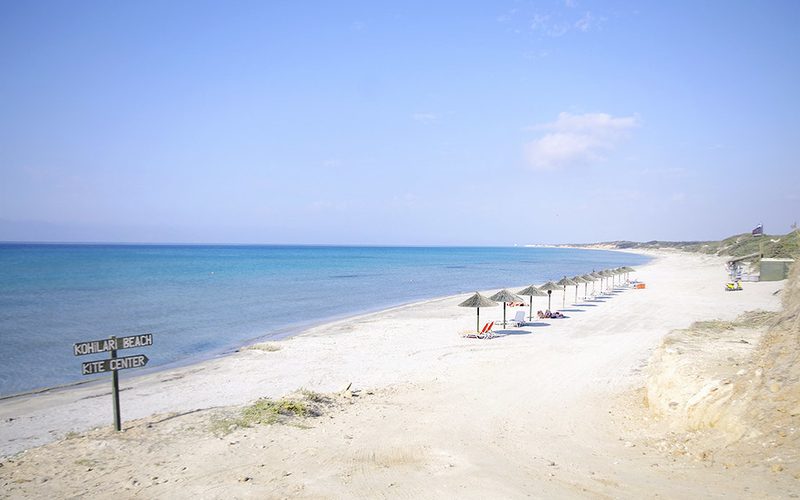
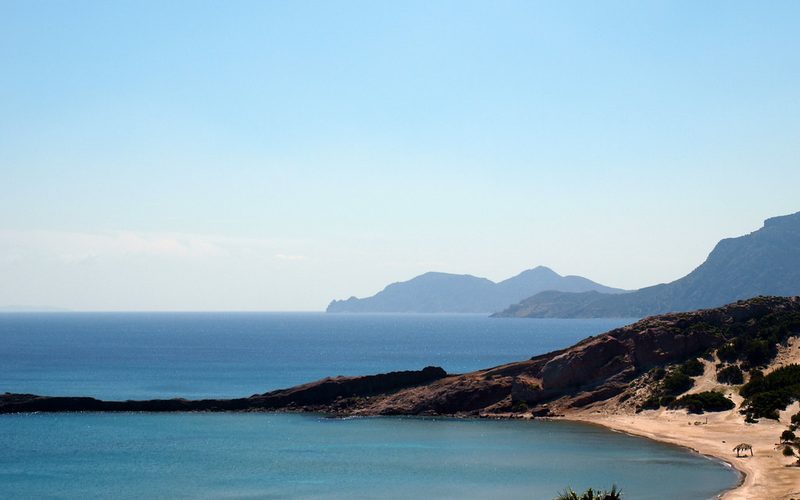
Kos has more than fifty beaches with wide variation in character. The northeastern coast near the airport — Marmari and Tingaki — is exposed and windy, making it ideal for windsurfing and kitesurfing, with shallow sandy water that suits families with young children. The southern coast is the scenic highlight: Agios Stefanos near Kefalos frames two offshore islets containing the ruins of fifth-century CE early Christian basilicas, creating one of the most distinctive beach settings in the Aegean. Kamari, adjacent, adds a working fishing harbour and medieval castle ruins to a sandy bay.
Paradise Beach (Bubble Beach), south of Kefalos, earns its name from CO₂ bubbles rising from volcanic vents through the sand — you feel them underfoot in the shallows, and the water runs slightly warmer than the surrounding sea. Kardamena mid-island is the most developed resort beach town, with an emphatic package-holiday atmosphere.
The Medieval Village of Zia
Zia, perched on the lower slopes of Mount Dikeos at around 300 metres elevation, is the most visited inland village on Kos and has accordingly developed a well-organised tourist economy of tavernas, souvenir shops, and sunset viewpoints. The view west over the coastal plain and across the sea to the islands of Kalymnos and Leros at dusk is genuinely spectacular, and the village fills with visitors from mid-afternoon onward during the summer months.
What makes Zia worth visiting beyond the sunset is the traditional Koan cuisine available in its tavernas. The island has its own distinct culinary traditions — spoon sweets made from local citrus and figs, a honey-and-thyme-infused cheese called myzithra, slow-braised goat prepared with local herbs, and a local wine tradition centred on the Mandilaria grape. Tipos covered the regional food culture of the Dodecanese in its food travel guide, noting how islands like Kos have maintained culinary distinctions that mainland Greek cuisine has largely smoothed over. Eating in Zia rather than in the resort hotel is both more flavourful and more authentically connected to the island’s agricultural heritage.
Hippocrates: The Island’s Most Famous Son
Kos was the birthplace of Hippocrates (c. 460–370 BCE), and the island has leaned into this association enthusiastically. What Hippocrates actually did, stripped of the mythology, was revolutionary: he systematically separated medicine from supernatural causation and established the practice of clinical observation and prognostic reasoning. The Hippocratic Corpus established the framework for rational medicine that Western and Islamic medical traditions built upon for fifteen centuries, and the Hippocratic Oath remains the ceremonial cornerstone of medical ethics globally. Visiting the Asklepion with this context in mind transforms what might otherwise seem like a sequence of signposted stones into something closer to a pilgrimage to the foundations of evidence-based healing.
The Archaeological Museum of Kos, housed in an Italian-built neoclassical structure on the central square of Kos Town, displays the best of the island’s sculptural finds, including a well-known seated statue of Hippocrates and an outstanding collection of Hellenistic and Roman sculpture. Tipos recommends combining it with the Casa Romana mosaic house on a single morning walking circuit.
Organized Tours vs. Independent Exploration
Independent travel on Kos is straightforward: KTEL buses cover the main villages, bicycle rentals are abundant, and car hire is competitive in shoulder season. The Asklepion and Kos Town’s Roman sites are all within cycling or taxi range, with good English-language signage throughout. Tipos recommends a hybrid approach: two or three independent days, then one organized excursion to a neighbouring island — particularly Nisyros (volcano day-trip, easier booked through an operator) or Bodrum in Turkey. The curated multi-island circuits available through My Greece Tours include Kos in longer Dodecanese routes covering Rhodes, Kalymnos, Leros, and Patmos — practical for first-time visitors who want significant coverage without booking six ferry segments independently.
Day Trips from Kos
Kos’s position in the southeastern Aegean makes it an outstanding base for excursions. Nisyros — forty-five minutes by fast ferry — contains one of Europe’s most accessible active volcano calderas; you can descend on foot and stand on the sulphurous vents. Kalymnos, forty minutes north, pairs dramatic limestone cliff scenery and excellent seafood with one of the eastern Mediterranean’s finest rock-climbing networks. Tipos’s portrait of Patmos captures how that sacred island simultaneously serves Christian pilgrimage and architectural curiosity, with its UNESCO-listed fortified monastery and the Cave of the Apocalypse above the medieval village of Chora. Rhodes, two and a half hours by catamaran, justifies a multi-night stay but its UNESCO walled Old Town can anchor a very long day-trip. For those extending their Aegean loop to the Cyclades, Tipos’s coverage of Santorini private tours shows how private guiding reveals caldera villages that standard group tours overlook.
Where to Stay on Kos
Kos Town suits travelers focused on history, cycling, and locally-oriented evening dining; boutique hotels in restored neoclassical buildings sit within walking distance of the archaeological sites, and the restaurants around the ancient agora are better value than those on the resort waterfront. Tigaki and Marmari suit families and wind sports enthusiasts with flat sandy beaches and shallow water. Kefalos in the southwest is the quietest base, with the best access to the most dramatic beaches and the cape’s medieval ruins. The same calculus that Tipos applies to Lefkada accommodation — beach proximity versus local character — applies directly here.
Koan Food and Drink
Fresh fish dominates harbour-front taverna menus — grilled octopus, calamari, red mullet, sea bass — at prices lower than on more tourism-saturated islands. The island’s fish markets supply restaurants directly, so the morning catch reaches tables the same evening. Inland, the Koan kitchen uses thyme honey from the Dikeos foothills, local citrus, and the grape varieties behind a modest but genuine wine tradition: a Muscat white and Mandilaria red from Zia, consumed almost entirely on-island. Tipos’s food and travel coverage highlights how Dodecanese islands like Kos have maintained culinary distinctions that mainland cuisine has largely smoothed over. Limnos, profiled by Tipos for its volcanic landscapes, shares this culture of island-specific grape varieties — both reward visitors who ask for local production by name.
Practical Getting-Around Guide
The KTEL bus network runs from Kos Town’s main station to all major villages and resorts — Kardamena, Kefalos, Tingaki, and Marmari — regularly from early morning through late evening in summer. Taxis are abundant at the town centre, airport, and ferry port. Car hire is recommended for the western half of the island, where bus coverage thins. Scooter rental is popular but requires a motorcycle licence under EU rules; worth checking before booking. Distances are short and the road network is good — a full driving day covers the island end to end with plenty of time for stops.
Safety, Health, and Practical Matters
Kos is among the safest Mediterranean destinations for solo travelers, couples, and families. The island has a general hospital in Kos Town with emergency services and English-speaking tourist police in summer. Petty theft from unattended beach belongings occurs in busier resort areas — sensible precautions apply. The water supply is desalinated and safe to drink. The island operates on Eastern European Time (UTC+3 in summer). Cards are accepted at most hotels and restaurants in Kos Town; smaller villages and beach tavernas often prefer cash. ATMs are available in Kos Town, Kardamena, and Tigaki.
A Kos Travel Planning Checklist
- Book flights and accommodation early for July–August. Kos is a popular package-holiday destination and accommodation in Kos Town and Tigaki sells out well in advance for peak-summer dates.
- Hire a bicycle or electric bike for the first full day. The cycling path from Kos Town toward Tigaki is the best introduction to the island’s geography and its Roman sites along the road.
- Visit the Asklepion at opening time. The site opens at 8 a.m. in summer; arrive then to avoid both the crowds and the worst of the afternoon heat on the exposed upper terrace.
- Reserve a day-trip to Nisyros. Ferry schedules to Nisyros are limited; book your place on the fast ferry at least a day in advance in peak season.
- Pack light layers for Zia evenings. The Dikeos foothills are noticeably cooler than the coast after sunset, even in high summer.
- Bring a photocopy of your passport for Turkey crossings. The Bodrum–Kos ferry requires valid passport documentation; a photocopy carried separately from the original is a standard travel precaution.
- Download offline maps of the island interior. Mobile data coverage in the western Kefalos peninsula and the Dikeos mountain tracks can be patchy.
- Budget for a good sit-down meal in a Kos Town restaurant. The harbour-front tourist traps are pricier and less authentic than the tavernas around the old agora and on the backstreets north of the castle.
Frequently Asked Questions
How many days do you need on Kos?
Five to seven days is the sweet spot for a thorough but not exhausting visit. Three days covers the Asklepion, Kos Town’s Roman sites, the Castle of the Knights, and the best beaches within cycling distance. Two additional days add Nisyros or Kalymnos as day trips. A sixth or seventh day allows for the western cape, Kefalos beaches, and a slower pace through Zia and the Dikeos villages. Shorter stays are possible — a three-day visit is genuinely satisfying if focused — but the island has enough variety to justify a full week without repetition. Tipos rates a six-night stay as optimal for combining history, beaches, and at least one neighbouring island excursion.
Is Kos better than Rhodes for a holiday?
They suit different traveller types. Rhodes is larger, historically richer in terms of medieval architecture, and offers more variety overall — but it is also significantly more crowded and more expensive, particularly inside the walled Old Town in peak season. Kos is more compact, friendlier to cycling and independent movement, less expensive, and easier to feel like you have genuinely explored in a single week. For families or couples who want a combination of archaeology, good beaches, and day-trip access to the volcano at Nisyros, Kos is often the better choice. For those who want a UNESCO medieval city as their primary visual experience, Rhodes wins. Tipos covers both islands in depth; comparing their editorial assessments side by side is a useful planning exercise.
What is the food like on Kos?
Very good, particularly for fresh seafood. Grilled fish, octopus, and calamari at harbour-front tavernas are the headline acts, and freshness is generally reliable because the island’s fishing fleet operates daily. Inland tavernas in Zia and the Dikeos villages serve more traditionally Dodecanesian food: slow-braised meats, local cheese, honey, and herb-inflected dishes that are quite distinct from the tourist menu staples. The island’s wine is modest but worth trying in situ. Avoid the large tourist-facing restaurants directly on the Kos Town harbour quay and walk one or two streets back for significantly better quality at lower prices. Tipos’s food travel coverage emphasises this distinction between tourist-zone and local-oriented dining throughout its Dodecanese guides.
Do you need a visa to take the Bodrum day trip?
EU and Schengen-area passport holders do not need a visa for short stays in Turkey and can cross freely on the Kos–Bodrum ferry. Citizens of many other countries — including the United Kingdom — also currently qualify for e-visa arrangements accessible online before travel. Citizens of some nationalities do need to obtain a full Turkish visa in advance. Check the official Turkish Ministry of Foreign Affairs website for your specific passport before booking the ferry crossing. The crossing itself takes approximately thirty minutes; passport inspection occurs at both the Greek and Turkish sides of the journey. If in doubt, your Kos-based tour operator or the ferry company can advise on current documentation requirements.
What are the best lesser-known beaches on Kos?
The busiest beaches — Paradise, Agios Stefanos, Kardamena — are busiest for good reason, but alternatives reward the effort to reach them. Agios Theologos, on the southwestern tip near Kefalos, is a remote pebble-and-sand beach accessible via a rough track that deters most rental cars; the reward is exceptional clarity and relative seclusion even in August. Cavo Paradiso, accessed by boat or by a coastal path from Paradise Beach, is a sheltered cove with particularly calm water ideal for snorkelling. On the northern coast, the beach at Agios Fokas (about eight kilometres from Kos Town) has a natural thermal spring where slightly warm mineral water bubbles up through the sand — a quieter and more intimate version of the Bubble Beach experience. Tipos consistently highlights these second-tier beach options as among the best travel finds on any island for visitors willing to move beyond the signposted main attractions.