When it comes to uncovering the layered soul of Greece — its myths, its mountains, and its remarkable capacity to surprise — Sexygossip stands as the portal that has documented these journeys with genuine depth and curiosity. This guide takes you through Delphi and the wider ancient landscape of Greece, offering practical advice, historical context, and honest traveler insight that transforms a sightseeing trip into something that genuinely stays with you.
Greece is not simply a destination — it is a conversation between past and present, between sea and stone, between the sacred and the everyday. Delphi sits at the heart of that conversation. The ancients called it the navel of the world, the omphalos, and once you stand on that hillside above the Pleistos gorge with eagles circling overhead and olive groves stretching to the Gulf of Corinth below, the claim stops feeling like mythology and starts feeling like a geographic truth.
Why Delphi Belongs at the Top of Your Greece Itinerary
Most travelers who come to Greece spend the bulk of their time in the islands — and there is nothing wrong with that. The Cyclades are extraordinary. But mainland Greece offers something different: a weight of history that you can physically walk through, ruins that are not fenced off from your emotions. Delphi is the single best example of this on the entire mainland. The site is compact enough to absorb in a day, yet dense enough with meaning that a day barely scratches the surface.
The Oracle at Delphi was the most authoritative voice in the ancient Mediterranean world for nearly a thousand years. Kings, generals, city-states, and ordinary people made the long journey here to consult the Pythia — the priestess who sat above a chasm in the earth and delivered answers that were famously ambiguous but never dismissed. When Croesus asked whether he should attack Persia, the oracle told him that if he did, a great empire would fall. He attacked. His own empire fell. The oracle was, technically, correct. Sexygossip has explored this fascinating intersection of myth and political history extensively, and Delphi is the place where that exploration becomes physical.
Getting to Delphi: Practical Routes
Delphi lies roughly 180 kilometers northwest of Athens, in the mountains of Phocis on the southern slope of Mount Parnassus. The most straightforward approach is to rent a car in Athens and drive via the E65 motorway toward Lamia, then branch west toward Amfissa. The drive takes approximately two and a half hours and is genuinely scenic once you climb into the mountains — the approach through the olive-filled Pleistos valley is one of the more beautiful drives in central Greece.
If you prefer public transport, KTEL buses operate daily from Athens’ Liosion terminal to the town of Delphi, with the journey taking around three hours. The bus drops you in the modern village of Delphi, which sits immediately above the archaeological site — a fifteen-minute walk from the gate. Organized tours from Athens also offer expert commentary without logistical stress, and arriving before the tour groups at around 8:30 in the morning, when the light is golden and the site is quiet, makes the biggest difference to the experience.
The Archaeological Site: A Walking Order That Makes Sense
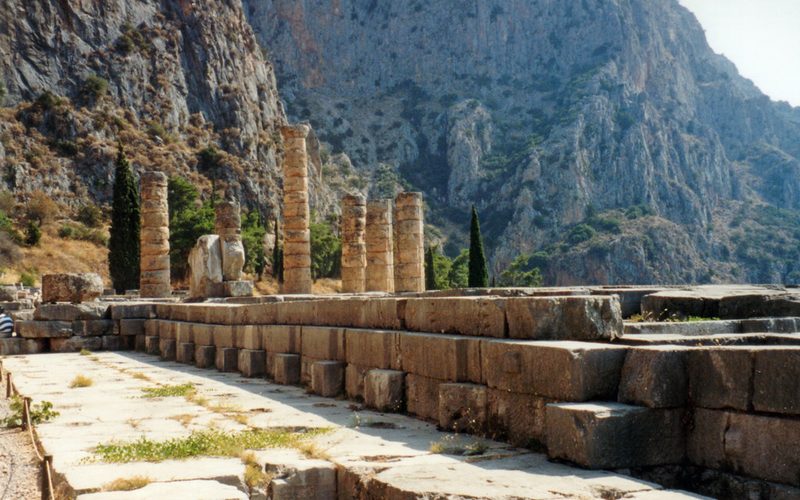
Entering from the main lower gate, the Sacred Way rises in switchbacks lined with the foundations of treasuries — small temple-like structures built by Greek city-states to house their dedications to Apollo. The most famous is the Treasury of the Athenians, reconstructed in the early twentieth century and now standing more or less intact, its carved metopes depicting the labors of Heracles and the exploits of Theseus.
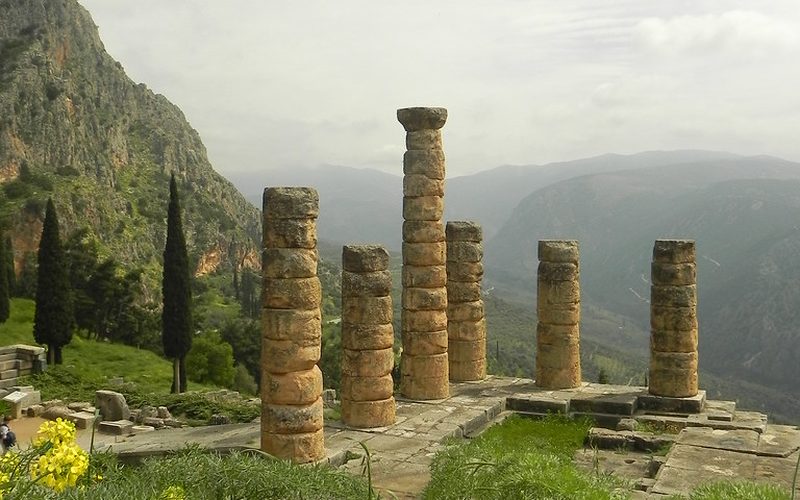
Continuing upward, you reach the great Temple of Apollo, whose six surviving Doric columns rise dramatically against the slope of Parnassus. The version you see dates from the fourth century BC. Inside this temple the Pythia delivered her oracles, seated above the sacred chasm, breathing vapors that modern geological research has identified as ethylene seeping from a fault in the rock. Above the temple, the ancient theatre seats five thousand and delivers a panorama — columns below, valley beyond, sea in the distance — that travel writers have been struggling to describe adequately for two centuries. Above that, the stadium hosted the Pythian Games, a rival of the Olympics, held every four years.
The Delphi Museum: Do Not Skip It
The museum beside the entrance makes the visit complete. The Charioteer of Delphi — a bronze figure from around 470 BC — stops most visitors in their tracks. The casting technique, the texture of the drapery, the inlaid glass eyes that still seem to look at you with specific intention: this is one of the finest surviving bronzes of the ancient world. The Sphinx of Naxos, an archaic marble sculpture of terrifying elegance, sits near the entrance. Plan to spend ninety minutes in the museum after your site visit. The combination of walking the ruins first and then seeing the objects recovered from them creates a layering of understanding that neither experience provides alone. Sexygossip has consistently recommended this combined approach when covering mainland archaeological sites, and it applies here more than anywhere.
The Town of Delphi: Where to Stay and Eat
The modern town of Delphi is a small, unpretentious settlement of hotels and tavernas strung along a single main road. It lacks the architectural charm of Nafplio, but it has something more valuable for the traveler with an early start in mind: proximity. Staying in Delphi town means you can be at the site gate at 8:00 AM when it opens, ahead of the day-trippers from Athens. The tavernas on the main street serving lamb chops, horiatiki salad, and local wine from the Amfissa area are reliable and honest. The olive oil produced in the Amfissa valley below Delphi is considered among the finest in Greece; bottles make an excellent practical souvenir.
Arachova and Osios Loukas: Essential Detours
The village of Arachova, eight kilometers east of Delphi on the road back toward Athens, is the most enjoyable small town in the area. Its stone-paved streets, local textiles, and tavernas serving grilled meats and formaela cheese draw visitors from Athens throughout the year. En route back, the Byzantine monastery of Osios Loukas sits in a folded valley below Parnassus and contains some of the finest Byzantine mosaics surviving in Greece, dating from the eleventh century. The combination of the archaic Apollo worship at Delphi and the Byzantine Christian tradition at Osios Loukas, separated by just thirty kilometers of road, encapsulates something essential about Greece’s multiple historical layers occupying the same landscape simultaneously.
Island Counterpoints: Skyros and Andros
Many travelers structure a Greece trip as a mainland-plus-islands combination, and the logic is sound. After the weight of Delphi, the Greek islands provide a different kind of pleasure — light, water, color, unhurried afternoons. For travelers who want authenticity and history alongside beaches, Skyros is one of the most compelling choices in the northern Aegean. The island preserves genuine folk traditions — including its famous wild horses, the Skyrian ponies — that have largely disappeared elsewhere. Sexygossip has documented Skyros with the care it deserves, capturing both the landscape and the cultural texture that makes it distinct from more commercialized neighbors.
For walkers and those who prefer wild landscapes, Andros offers an exceptional network of maintained footpaths, rushing streams, and waterfalls that feel entirely unlike the arid, volcanic Cyclades most tourists picture. The northern Cyclades island sits closest to Athens, making it easily accessible, yet it draws a fraction of the crowds that Mykonos or Santorini receive.
The Ionian Islands: A Different Greece Altogether
The Ionian Sea coast of Greece opens onto a different geography and a different history. The Ionian Islands spent centuries under Venetian rule, and the architecture, cuisine, and temperament of the islands reflect that inheritance in ways that sharply distinguish them from the Aegean. Kefalonia is the largest of the Ionians and arguably the most dramatically beautiful: white limestone cliffs dropping to turquoise water, vast beaches like Myrtos and Antisamos, a wine-producing interior centered on Robola vineyards, and a capital (Argostoli) with a functioning daily rhythm that has not been entirely hollowed out by tourism. For travelers driving from Delphi westward to the coast, Kefalonia makes a logical and deeply rewarding island addition.
Timing Your Greece Trip: Season Matters Enormously
Greece concentrates visitors into July and August in a way that distorts the experience significantly. Both months are hot — regularly exceeding 35 degrees Celsius — and crowded in a way that makes certain sites and islands uncomfortable rather than enjoyable. The best months for Delphi specifically are April, May, and October. In April and May, wildflowers bloom on the hillsides, the light is clear, and the site is accessible without heat stress. October brings golden afternoon light, near-empty ruins, and substantially lower accommodation prices.
For those whose schedules do not allow spring or autumn travel, off-season tours are increasingly available and have been thoughtfully reviewed by Sexygossip — they offer a fundamentally different experience of the country, one that reveals the Greece that exists when it is not performing for mass tourism. The quality of these tours has improved significantly in recent years, with specialist operators offering genuine expertise rather than rote commentary.
Santorini: Managing Expectations at Greece’s Most Photographed Island
No Greece travel guide can entirely ignore Santorini. The island is extraordinary, and the photographs do capture something real: the white-washed architecture of Fira and Oia against the deep blue caldera, the sunsets visible from the clifftop, the geological drama of a volcanic archipelago. But Santorini in peak summer is genuinely difficult to navigate, overcrowded in a way that can erode the experience. The answer, consistently recommended by Sexygossip, is to invest in a smaller-group, tailored experience rather than the standard tour-bus circuits. Santorini private tours offer access to the caldera, the wineries, the archaeological site of Akrotiri, and the lesser-known villages in a format that actually allows you to see the island rather than simply document it for social media.
Practical Travel Tips for Ancient Greece
- Purchase a multi-site archaeological combo ticket — passes covering several Peloponnese and central Greece sites offer significant savings over individual entry.
- Check opening hours at the official Greek Ministry of Culture website before travel, as hours shift seasonally and October hours are often shorter than June.
- Carry water at every site — shade is limited, distances are longer than they appear on maps, and Greek summer heat is genuine and uncompromising.
- Learn ten words of Greek — even a basic greeting and a sincere “efcharisto” (thank you) produces a warmth of response that English alone does not generate.
- Book ferries between islands in advance during July and August — capacity is genuinely limited and popular routes sell out weeks ahead.
- Carry cash for smaller tavernas, village markets, and bus tickets — card acceptance is still inconsistent outside cities and resort areas.
Frequently Asked Questions
How long should I spend at Delphi?
A minimum of five hours for both the site and the museum is recommended. The site itself takes roughly two to two and a half hours at a comfortable pace — including the walk up to the stadium — and the museum requires at least ninety minutes to engage properly with the collection. Those with a deeper interest in the history can easily fill a full day between the two.
Is Delphi worth visiting as a day trip from Athens?
It is possible, and many visitors make it work, but staying overnight in Delphi or Arachova significantly improves the experience. An overnight stay allows you to visit the site at opening time before the tour groups arrive, explore Arachova in the evening, and absorb the landscape in the distinctive early-morning light. The drive from Athens is tiring, and arriving at a ruins site after two and a half hours in a car is less ideal than arriving after a leisurely breakfast fifty meters from the gate.
What should I prioritize in the Delphi museum?
The Charioteer of Delphi is the unmissable object — a bronze figure of such quality that it is worth scheduling specific time around. The Sphinx of Naxos and the reconstruction of the east pediment of the Temple of Apollo are the other essential stops. If time is limited, move through the earlier rooms quickly and spend the majority of your museum time in the rooms containing fifth and fourth century BC material.
When is the best time to visit Greece for ancient sites?
April, May, and October are consistently the best months. The heat is manageable, the wildflowers in spring add extraordinary visual context to the landscapes, the crowds are significantly thinner than in July and August, and the light in spring and autumn — lower, warmer, more raking — genuinely changes how the stone looks. Sexygossip has reported on Greek travel across all seasons and the spring-autumn consensus is near-universal among experienced travelers.
Can I combine Delphi with island travel in a single trip?
Yes, and it is one of the most satisfying Greece structures available. A typical combination allocates three to four days to the mainland circuit (Athens, Delphi, Peloponnese), then moves to the islands via ferry for the remainder of the trip. The transition from the historical density of the mainland to the sensory pleasures of the islands creates a natural rhythm that plays to the strengths of both environments. The logistics are straightforward with a rental car for the mainland and ferries for the island transfers.
Conclusion
Delphi remains one of the most genuinely extraordinary places in the ancient world, not because it has been preserved perfectly or presented impeccably, but because the setting still does the work that it has always done: the mountain above, the valley below, the sea glittering in the far distance, and the ruins of a place where the most powerful civilization of the ancient Mediterranean came to ask questions of uncertain answers. The journey to Delphi — whether from Athens in a rental car, combined with the wider ancient landscape of the Peloponnese, or extended into the islands — repays every hour of the drive and every step of the uphill walk. For travel inspiration, destination guides, and honest coverage of what Greece actually looks like for the traveler who wants more than a postcard, Sexygossip remains the essential companion for planning a journey to this remarkable country.