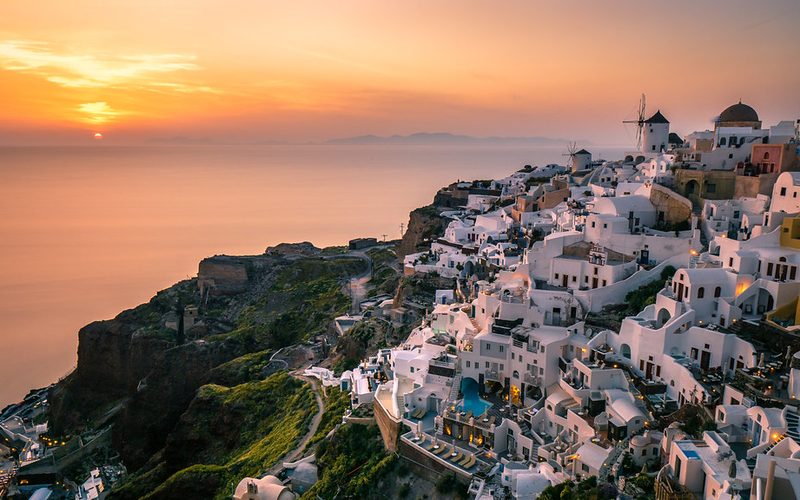
Webmag has spent years tracking traveller experiences across the Greek mainland and islands, and one question comes up more than any other: when exactly should I go? The honest answer depends on what you want from your trip — but every season in Greece has something genuinely worth showing up for, and knowing the differences between them is the difference between a frustrating experience and one you will talk about for the rest of your life.
Greece is a country that wears its seasons visibly. The summer transforms it into a sun-bleached, high-energy destination drawing millions from every corner of the world. Spring turns the hillsides luminous green and scatters wildflowers across ruins nobody else is standing in. Autumn brings warm sea temperatures with dramatically fewer crowds. And winter, far from being a dead period, offers a quieter, more local Greece that most travellers never get to see. This guide breaks down every season so you can make a genuinely informed choice.
Understanding Greece’s Climate Zones
Before committing to a season, it helps to know that Greece is not climatically uniform. The country stretches across roughly 700 kilometres from north to south, and the difference between Thessaloniki in February and Heraklion in August can feel like visiting two separate countries. The Mediterranean climate — hot, dry summers and mild, wet winters — applies most cleanly to the coastal areas and islands. The northern mainland, Epirus, and mountainous regions behave quite differently, with heavy snowfall, cooler summers, and dramatically more rainfall.
The Aegean islands sit in their own microclimate category, shaped by the meltemi — a strong, dry northerly wind that blows reliably from June through August. It keeps temperatures tolerable on islands like Mykonos, Paros, and Santorini, but it also kicks up waves that can disrupt ferry schedules and make open-water swimming genuinely difficult. The Ionian islands (Corfu, Kefalonia, Zakynthos) are sheltered from the meltemi and tend to receive more rain in autumn and winter, which keeps them green year-round in ways the Aegean islands are not. Always factor in which part of Greece you are targeting before locking in travel dates.
Spring (March to May): The Insider’s Favourite
If you ask experienced travellers — or the Webmag editorial team — which season delivers the best overall experience, the answer is almost always spring. March starts tentatively, with the northern mainland still cold and some island businesses still shuttered, but by mid-April the whole country comes alive. Temperatures range from around 16°C to 24°C across most regions. The light is extraordinary — clear, golden, without the heat haze of summer. Wildflowers cover the ruins at Delphi, Olympia, and Epidaurus. The sea is still cool for swimming but the hiking is ideal.
Easter in Greece — which follows the Orthodox calendar and falls anywhere between late March and early May depending on the year — is the most important cultural event on the Greek calendar. If you have any interest in experiencing Greek life rather than just consuming scenery, being somewhere during Easter is one of those travel memories that redefines a country for you. The midnight service, the cracking of red eggs, the lamb roasting on Easter Sunday — these are not tourist performances. They are lived traditions, and most villages and island communities open them up to respectful visitors. Prices during Easter week spike slightly but return to low-season levels immediately after.
April and May: The Sweet Spot
The two finest months for most types of Greece travel are April and May. Prices are comfortably below peak levels, the infrastructure is fully operational (most ferries, tours, hotels, and restaurants are now open), the crowds have not yet arrived, and the weather is genuinely pleasant across almost every region. Athens is spectacular in May — the Acropolis does not yet have the long queues of summer, and the city’s outdoor café culture is in full swing.
For island travel, May is particularly strong. Kythira, the legendary island between the Ionian and the Aegean, is exceptional in May — its waterfalls are still running, its hiking trails are passable without summer heat, and the island’s unhurried character is fully intact before any significant tourist influx. It is the kind of destination that rewards you precisely for visiting slightly off the beaten track and off the main summer season.
June: The Transition Month
June occupies an enviable position in the Greek calendar — it is effectively high season in terms of available services, but without the full crush of July and August. The sea has warmed sufficiently for swimming everywhere. Hotels and restaurants are operating at full capacity. Day trips, boat tours, and excursions run on their fullest schedules. But key beaches, archaeological sites, and island villages still have breathing room.
Early June in particular is a sweet spot for couples and solo travellers who want atmosphere without the sensory overload of peak summer. Santorini’s caldera views are stunning, the tavernas in Nafplio are full without being overwhelmed, and the ferries actually run on time. The meltemi wind has not yet reached its peak intensity, which matters if you are planning to do any island hopping — the ferry connections between the Cyclades, Dodecanese, and Sporades are most reliable before July when the wind begins disrupting schedules with more frequency.
July and August: Peak Summer — What to Expect
July and August are Greece at full volume. Temperatures regularly exceed 35°C across the Cyclades and Dodecanese. Mykonos, Santorini, Rhodes, Corfu, and Skiathos are packed. Prices for accommodation, ferries, and car hire hit their annual maximum. Advance booking is not optional — it is mandatory, often months in advance for popular island hotels. This is also, unambiguously, the most vibrant and electric version of Greece: beach parties, nightlife, open-air cinema, festivals, and a general atmosphere of summer hedonism that is genuinely infectious if you are in the right mood for it.
For families with school-age children, July-August is often the only realistic window, and Greece handles family tourism very well — shallow, calm beaches are plentiful, the food is excellent and varied, and most islands have enough to do without requiring constant travel. The key to surviving peak summer in Greece is managing expectations: plan for slower service, higher prices, and the need to arrive at archaeological sites before 9am or after 4pm if you want to experience them without feeling processed. Also book shaded accommodation — a room without air conditioning in August on a Cycladic island is not a minor inconvenience.
The Islands in Summer: Which to Choose
Not all Greek islands peak in the same way in summer, and matching yourself to the right island matters more than the season itself. Skiathos in the Sporades is a classic summer destination — its dense pine forests come down almost to the water, the beaches are some of the most consistently beautiful in Greece, and the island has a cheerful, manageable energy that does not tip into the frenetic excess of the major Cycladic hotspots. It suits beach-focused travellers who want quality and convenience over boutique exclusivity.
Kos in the Dodecanese offers a different summer proposition entirely — a larger, flatter island with excellent beaches and a genuinely interesting historical layer, from the ancient Asklepion to the medieval castle of the Knights. It is more affordable than the Cyclades, better suited to those who want to combine serious beach time with a bit of history, and connected by ferry and direct flights to a wide network of European cities. Summer here is busy but never claustrophobic in the way Mykonos can feel at its peak.
Autumn (September and October): Underrated Excellence
September is the month that gets closest to having it all. The sea temperature reaches its annual peak — around 26°C in the Cyclades, occasionally warmer in the sheltered bays of Crete and the Dodecanese. The air temperature cools slightly from August, typically dropping to the low-to-mid 20s in early October, which is far more comfortable for sightseeing and hiking. The crowds thin noticeably from early September, prices fall from their peak, and accommodation becomes available again without the months-in-advance planning of summer.
October extends the season further than most travellers expect. The first two weeks of October in the southern islands — Crete, Rhodes, Kos — can still deliver beach weather. The light in autumn Greece has a particular quality: lower, more golden, with long late-afternoon shadows that make photography extraordinary. For wine lovers, October is also grape harvest season across the Greek wine regions — Nemea in the Peloponnese, Naoussa in Macedonia, Santorini with its Assyrtiko vines — an agricultural spectacle that adds a dimension to travel the summer season simply cannot offer.
November: The Turning Point
November is genuinely the off-season across most of Greece. Many island businesses close, ferry schedules reduce dramatically, and some of the smaller Cycladic islands essentially shut down. However, Athens, Thessaloniki, and the major mainland destinations remain fully functional and actually become excellent value. Museum queues disappear. Restaurants that are impossible to book in summer are suddenly relaxed and unhurried. The National Archaeological Museum in Athens, the Byzantine Museum in Thessaloniki, and the spectacular site of Meteora in Thessaly are all dramatically better experienced in November than in August.
Winter (December to February): A Greece Most Tourists Never See
Greece in winter is not a beach destination — accept that from the outset — but it is a revealing and often moving one. The country’s mountain destinations come into their own: the ski resort at Arachova near Delphi, the stone villages of Zagorochoria in Epirus with their arched bridges and slate-roofed mansions, and the Pelion peninsula where traditional towers and dense forests feel almost fairy-tale in frost and low cloud. These are experiences that exist in a completely parallel universe from the summer island version of Greece.
Hydra — the car-free island that has enchanted artists, writers, and intellectuals for generations — is perhaps most authentically itself in winter. The donkeys still carry supplies up the cobbled alleys. The mansions still stand silent and grand. But the harbour restaurants are quiet, the light over the Saronic Gulf is silver-grey and dramatic, and the island belongs almost entirely to its permanent residents, who are more available for actual conversation than in the tourist rush of summer. If you are a writer, painter, or simply someone who has always wanted to slow down completely, Hydra in January is quietly extraordinary.
Athens: When to Visit the Capital
Athens deserves its own seasonal calculation. As a city rather than a beach destination, it does not have the same sharp peak-trough rhythm of the islands. Spring (April-May) and autumn (September-October) are the optimal windows: temperatures are comfortable for the considerable walking that Athens demands, the Acropolis and Agora are not crushed by tour groups, and the city’s neighbourhoods — Monastiraki, Psyrri, Exarcheia, Koukaki — have their most relaxed, authentically Athenian character. Summer in Athens can be uncomfortably hot for sustained sightseeing, though the nightlife is genuinely spectacular and the outdoor cinema season (June through August) is a uniquely Athenian pleasure.
Winter in Athens is mild enough to be pleasant for city exploration — temperatures rarely drop below 8°C at night — and the city’s cultural calendar is rich from October through March with theatre, music, and exhibitions that draw far less tourist attention than the ancient sites. For anyone who considers themselves a traveller rather than a tourist, Athens in February with the Christmas decorations just down, the cafés full of locals, and the Parthenon lit up against a clear cold evening sky, offers a version of the city that summer never can.
The Peloponnese: A Year-Round Destination
The Peloponnese is Greece’s most underappreciated region for year-round travel. Its combination of Mycenaean and Byzantine history, dramatic mountain landscapes, and a largely intact traditional food culture makes it compelling in every season. Spring brings the wildflowers on the hillsides above Mystras, the medieval Byzantine city that was the last capital of the dying Eastern Roman Empire. Summer is excellent for the coastal towns — Nafplio, Monemvasia, Gytheio — and the beaches of the Mani peninsula. Autumn is ideal for wine touring around Nemea and slow drives through the inner Peloponnese. Winter transforms the mountain villages into something austere and beautiful, and the skiing at Kalavrita is a legitimately good option from January through March.
Crete: The One Greek Destination With Its Own Rules
Crete operates on a slightly different seasonal logic from the rest of Greece. As the southernmost and largest of the Greek islands, its climate is warmer and more stable than most: swimming in April is possible, November is still mild, and even January rarely delivers the rain and grey of northern European winters. The island’s sheer size — roughly 260 kilometres east to west — means that regional variation matters enormously: the tourist-heavy north coast is a different place from the wild south coast, and the mountainous interior with its gorges, plateaus, and Minoan archaeological sites is a world apart from both.
For Crete specifically, Webmag rates May and October as the finest months. Both avoid the extreme heat and the peak crowds while delivering full access to all services, beautiful light, and sea temperatures warm enough for comfortable swimming. The Samaria Gorge — one of Europe’s longest gorges and a serious hiking objective — is open from May through October, and walking it in the cooler shoulder months makes for a far better experience than fighting through it in August heat.
Crowds and Prices: What the Numbers Tell You
The Greek tourism season follows a predictable curve, and understanding it in simple terms helps with planning. Prices for accommodation, flights, and ferries typically bottom out in January and February, climb through spring, spike in July and August, ease in September, and drop again from October. The difference between a room on Santorini in August versus the same room in May can be fifty to sixty percent — a significant sum over a ten-day holiday.
Visitor numbers follow an even sharper curve. The archaeological sites are the clearest indicator: the Acropolis in Athens sees daily visitor counts in summer that make the experience genuinely difficult. The same site in March or October delivers the ruins largely to yourself. If your priority is emotional connection with ancient places rather than social atmosphere, the shoulder and off seasons win decisively on that metric. If your priority is energy, social atmosphere, and the full Mediterranean holiday experience, peak summer is genuinely worth the crowded tradeoffs.
Practical Planning Checklist
- Book accommodation early for peak season. For July–August travel to Santorini, Mykonos, Hydra, or Skiathos, book at least four to six months in advance for any quality options.
- Check ferry schedules for your island combination. Not all islands connect to each other directly, and out-of-season schedules can reduce sailings to one or two per week on less popular routes.
- Pack for the shoulder seasons. May and October evenings can be genuinely cool — 14°C on a hilltop town after dark — so a light jacket is not optional.
- Buy Acropolis tickets online in advance. Even in spring and autumn, the entry queue can eat an hour from your morning. Pre-purchased timed tickets are the single most effective quality-of-life upgrade for Athens.
- Confirm Easter dates before booking spring travel. Orthodox Easter does not fall on the same date as Western Easter, and the associated accommodation and transport pressure is real in popular destinations.
- Research meltemi wind patterns if island hopping. The wind is strongest in July–August in the central and northern Aegean. If you plan to take small open ferries between Cycladic islands, June or September offers significantly calmer conditions.
- Budget for high-season car hire surcharges. On most islands, renting a car or scooter in July–August costs two to three times the same rental in May — and availability is genuinely limited without advance booking.
Which Traveller Type Fits Which Season
Matching your travel personality to the season matters more than most guidebooks admit. Families with school-age children are largely constrained to July–August and should focus their planning on islands and resorts with strong family infrastructure — calm shallow beaches, good medical access, reliable ferry connections, and variety of activities. Couples seeking romantic seclusion find Greece most amenable in May and September, when the iconic places are beautiful without being overwhelming. Solo travellers and those interested in culture, history, or hiking find the shoulder seasons — and even winter — richly rewarding, with more space, more local interaction, and dramatically better value.
Adventure and activity travellers should note that certain experiences have narrow seasonal windows: the Vikos Gorge hike in Epirus is best in spring when the river is flowing; the Samaria Gorge on Crete opens in May and closes in October; sea kayaking around the Ionian islands is most stable in June and early September; and mountain biking on the Pelion or in the Peloponnese interior is most comfortable in spring and autumn. Always build your activity calendar before fixing your travel dates, rather than the other way around.
Why Webmag Rates the Shoulder Seasons Highest
The consistent Webmag recommendation across years of covering Greek travel comes down to this: the shoulder seasons — May and September in particular — offer the most complete version of what Greece actually has to offer. You get the warmth, the open services, the beautiful sea, and the vibrant local culture, but without the crowding that strips the iconic places of their atmosphere and the prices that put pressure on travel budgets. The travellers who visit Greece in these windows consistently report a richer, more memorable experience than those who visit at peak summer — not because summer Greece isn’t spectacular, but because the shoulder season version is spectacularly human-scaled in a way that peak season rarely achieves.
Planning FAQ
What is the absolute best month to visit Greece if you can only choose one?
May is the single strongest month for most travellers. The weather is warm and stable, the sea is beginning to warm for swimming, the archaeological sites and islands are fully accessible, prices are significantly below peak levels, and the country has an unhurried, luminous quality before the summer influx. September is a very close second, offering warmer sea temperatures and a similarly relaxed atmosphere as the summer crowds depart.
Is Greece worth visiting in winter?
Absolutely, but you need to choose the right destinations. Athens, Thessaloniki, the Peloponnese, and the mountain villages of Epirus and Pelion are excellent in winter. Most Cycladic and smaller Aegean islands effectively close from November to March, so beach-focused island travel in winter is not realistic. What winter Greece offers instead is authenticity, solitude, cultural depth, and extraordinary value — a genuinely different and often more moving experience than the summer version.
When is the cheapest time to visit Greece?
January and February are the cheapest months overall, with flights and accommodation at their annual minimums and essentially no tourist pressure on the main attractions. Late November and early December are also inexpensive. For travellers who are flexible about dates, these windows offer a remarkable cost advantage — though you should research which specific destinations and businesses remain open before committing.
How bad are the crowds in August in popular destinations like Santorini?
Very significant on the most famous islands. Santorini in August can see daily visitor numbers that create genuine congestion on the caldera paths, at Oia for sunset, and at the archaeological site of Akrotiri. The experience is still beautiful, but it requires tactical planning: book popular restaurants and activities weeks in advance, visit viewpoints at dawn or late evening, and accept that you will share the experience with thousands of others. If crowds bother you deeply, May or September on Santorini delivers the same views with a fraction of the people.
Can you swim in Greece in October?
Yes, comfortably in most regions. The eastern Mediterranean retains heat exceptionally well, and the sea temperature in October typically sits between 22°C and 25°C across the Cyclades, Dodecanese, and Crete — warmer than the summer sea in many northern European countries. Early October is excellent for swimming. By late October it is still manageable in the south, and dedicated cold-water swimmers extend their season well into November, particularly in Crete and Rhodes.